Considered by many to be the most common sound in English, the schwa is a rarely noticed but always present vowel, and it's absolutely essential for the English language to sound the way it does.
In this blog post, I'll explain what the schwa is, how to recognise it in speech, then I'll show you where it appears in a series of common words, and finally I'll answer some frequently asked questions.
What exactly is the schwa?
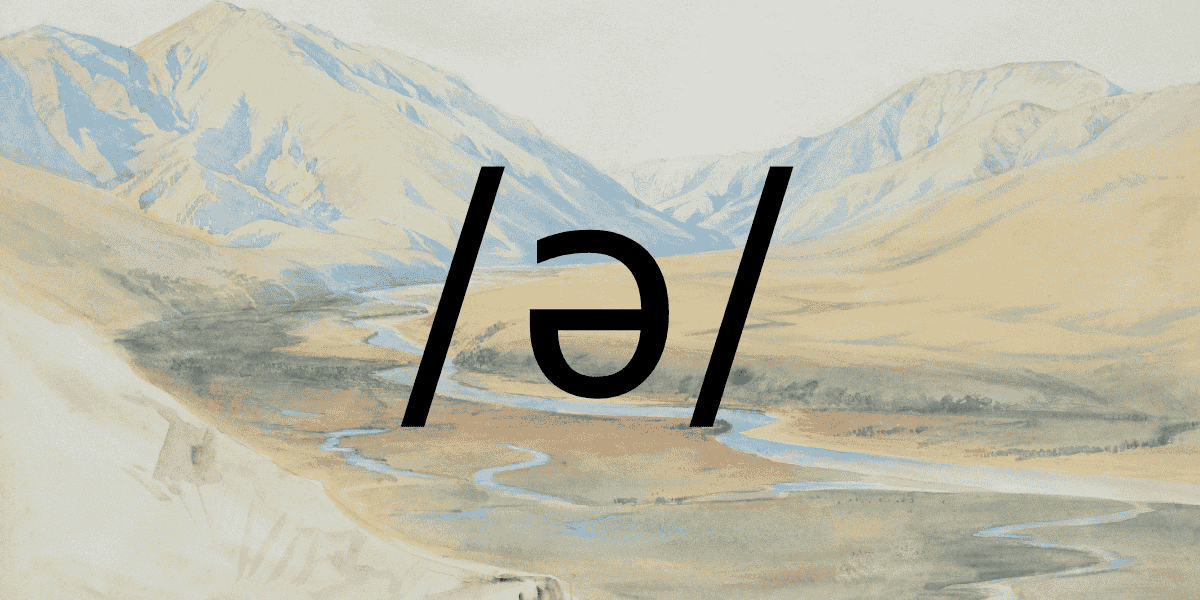
The schwa is a neutral vowel in English that sounds like "uh", for example the first sound in the word "about" or the last sound in the word "sofa". In the International Phonetic Alphabet (IPA), it's represented by the symbol /ə/. When you say it out loud, you'll notice that your tongue doesn't get pulled in any direction, it just sits relaxed in the middle.
It's usually referred to as an unstressed vowel, as it appears in parts of the word that don't need to be emphasised. This is because there's a natural beat in English where certain syllables are more highlighted than others, and the schwas appear where the syllables are reduced.
Take a look at this example: we pronounce the first "o" in "photograph" because it's a stressed syllable, but we substitute the first "o" sound for a schwa in "photography" because the stress has moved and it no longer falls on that first syllable, it falls on "to" instead.
How to spot it
The schwa isn't as easily recognisable as other vowel sounds, but if you pay attention you'll be able to spot it with no problem. Here are a few points to remember:
- You'll find the schwa in unstressed syllables. For example take the word "banana"; the second syllable is the stressed syllable, while the first and third are unstressed, that's why it sounds something like "baNAna", or phonetically transcribed /bəˈnɑːnə/.
- It has a soft and relaxed "uh" sound. Meaning that if it sounds vague or almost not there at all, it's probably a schwa.
- It won't be tied to a particular letter. A schwa can come from any vowel letter ("a", "e", "i", "o", "u", or "y"), because it's based on stress, not spelling.
- You'll find it more often in longer words. The more syllables a word has, the more chances that it'll use one or many schwas.
Common words that include a schwa
These are common words in English that include a schwa, either always or when they appear in unstressed positions:
Articles and prepositions
- a (as in "a coffee") → pronounced /ə/
- the (in casual speech) → often pronounced /ðə/
- to (as in "going to sleep") → pronounced /tə/
- of → pronounced /əv/
- from → pronounced /frəm/
Multi-syllable words
- about → /əˈbaʊt/ (first syllable)
- again → /əˈɡen/ (first syllable)
- sofa → /ˈsoʊfə/ (last syllable)
- banana → /bəˈnænə/ (first and last syllables)
- pizza → /ˈpiːtsə/ (last syllable)
- computer → /kəmˈpjuːtər/ (first and last syllables)
- elephant → /ˈelɪfənt/ (last syllable)
- family → /ˈfæməli/ (middle syllable)
- chocolate → /ˈtʃɒklət/ (middle syllable)
- camera → /ˈkæmərə/ (middle and last syllables)
Words ending in common suffixes
- Words ending in -er: teacher (/ˈtiːtʃər/), player (/ˈpleɪər/), doctor (/ˈdɒktər/)
- Words ending in -or: actor (/ˈæktər/), visitor (/ˈvɪzɪtər/)
- Words ending in -ar: grammar (/ˈɡræmər/), collar (/ˈkɒlər/)
- Words ending in -ous: famous (/ˈfeɪməs/), nervous (/ˈnɜːrvəs/)
- Words ending in -able: comfortable (/ˈkʌmftəbəl/), reasonable (/ˈriːzənəbəl/)
Place names
- London → /ˈlʌndən/ (last syllable)
- America → /əˈmerɪkə/ (first and last syllables)
- China → /ˈtʃaɪnə/ (last syllable)
- Boston → /ˈbɒstən/ (last syllable)
- Texas → /ˈteksəs/ (last syllable)
Words that change based on stress
Some words contain schwas only when they are function words (unstressed), but not when they're emphasised:
- can → stressed: /kæn/ ("Yes, I CAN!"), unstressed: /kən/ ("I can help")
- was → stressed: /wɒz/ ("It WAS good"), unstressed: /wəz/ ("It was okay")
- and → stressed: /ænd/ ("bread AND butter"), unstressed: /ənd/ or /ən/ ("nice and easy")
FAQs
The schwa appears so frequently because English is a stress-timed language which tends to reduce vowels wherever possible. When speaking English, we only stress certain syllables—the rest can contain schwas and still get the meaning across.
Yes, you should definitely try to incorporate the schwa when you speak. It will take you much closer to sounding native and it will also help you speak more quickly and effortlessly.
No, it doesn't. When a syllable is stressed, the vowel will be pronounced with its full quality. Vowels only get reduced to a schwa if they are part of an unstressed syllable.
I'm afraid not. There are no rules that indicate which particular letters can become schwas. For example, the "a" in "man" is pronounced fully, whereas the "a" in "about" becomes a schwa.
Because it creates a disconnect between how we say words and how we write them. Take the word "remember": the first "e" is an /ɪ/ sound, the second "e" is an /e/ sound because that syllable carries the stress, and the final "e" is a schwa /ə/. Not easy, eh?
Conclusion
The schwa might be subtle, but it plays such a big role in making English sound the way it does, as it allows for a rhythm that goes back and forth between stressed and unstressed syllables.
If you haven't practiced noticing it yet, I recommend giving it a try. You'll realise how prevalent it is and how it smooths out words and sentences, making the syllables much easier to pronounce.